Ehrenfried Walther von Tschirnhaus
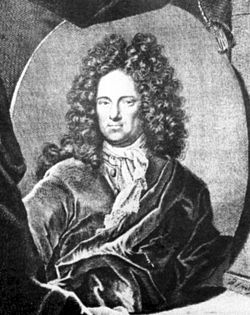
The N-Ellipse, a generalized form of the ellipse, is also known as the Tschirnhaus'sche Eikurve, named after the German Ehrenfried Walther von Tschirnhaus. Tschirnhaus was a contemporary of Johann Bernoulli and even kept correspondence with Leibnitz. He created the Tschirnhaus transformation, a way to reduce terms in certain polynomials; he also worked with curves, lenses, and refractions, which is likely the reason his name served as an eponym for an n-ellipse's alias. Tschnirnhaus also participated in philosophy, and corresponded with Spinoza during his creation of Ethics.
Tschirnhaus is considered to be the creator of European porcelain. After success in his experiments, which used mirrors to create high temperature processes, the government of Saxon, Germany began creation of factories to produce his porcelain. However, shortly after finding a production ready technique, he died of dysntery, and the credit for his work was attributed to his reportedly crooked assistant, Johann Friedrich Bottger.